Friday, January 22, 2010
Thursday, December 31, 2009
Julie Marton: Beaded Mosaic Vessels
Biography
Julie Marton’s glass art works are handcrafted in her studio in suburban Chicago. She is a graduate of the School of the Art Institute of Chicago. After college, she began her career as an art consultant and went on to art gallery management. In 2000, after the birth of her first daughter, she began working for a Chicago area art, design, and architecture museum. As the museum’s program director, she had the opportunity to curate many exhibitions of regional, national, and international artists and artisans, as well as administer the museum’s annual national architecture awards and international design competition.Throughout her career she has been creating and refining the method and design of her personal body of work, a unique line of embellished glassware.
Her mission is to create inspirational, hand-embellished glass vessels that delight the viewer and are functional works of art. She perceives her work as "sculptural paintings" employing the varieties of colors, translucencies, and lusters intrinsic in glass beads to enhance the shape and volume of the glass vessel.
It is important to the artist that she reuse existing materials whenever possible. She has made it a point to give new life to secondhand glass vessels and vintage or salvaged beads. Only a percentage of each art work includes vintage beads, but Marton especially prizes the mellowed patinas of vintage beads and is constantly on the hunt for them.
Friday, December 11, 2009
New Arrival: "Do You Remember Me" #279 by Roy Fairchild-Woodward
Let us know if we can custom frame "Do You Remember Me" for your home.
Sunday, November 29, 2009
Portfolio: Private Residence

This next painting is a crisp and colorful Mediterranean scene by the artist Hajto. The painting is so inviting and your eye travels up those steps to the cafe or strolls along the waterfront.

These two gems are detailed paintings of charming European village windows by Dvornik. In addition to being beautiful works of art, they look so wonderful in this room. Sometimes the right art work completes a room like the missing pieces of a jigsaw puzzle. That was certainly the case with these.


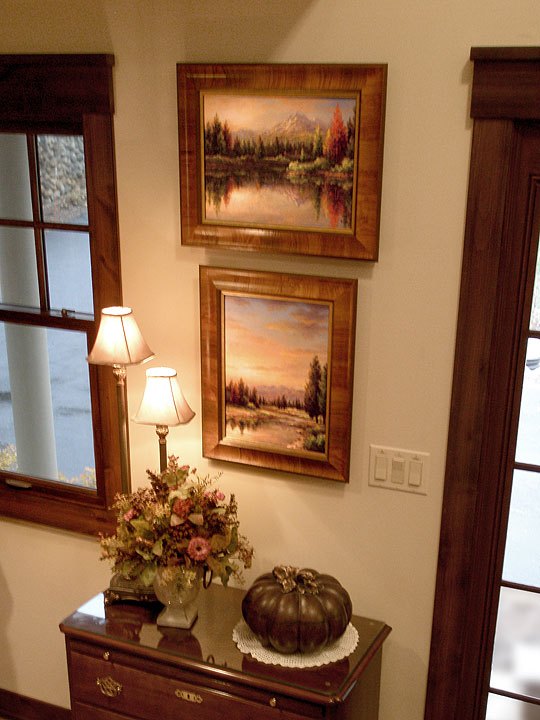
Above the set of two landscapes is another larger landscape by Munoz hung across from the staircase above the second storey entryway. The homeowners will enjoy a lovely continuity of view afforded by having three landscapes by the same artist in the entryway. The atmosphere created by these majestic, warm landscapes is a great way to welcome visitors and set a comfortable mood for the rest of the home.
Sunday, November 15, 2009
Dvornik a.k.a. Iouri Khamitov
Biography: Iouri Khamitov, nom de plume Yuri Dvornik, was born in 1947 in Vladikavkaz City, Russia. He attended the Moscow School of Art to study painting and art restoration. He worked as a restorer for a time "giving new life to old paintings." He also trained as an architectural designer. Dvornik's paintings are realistic in style and yet idealist in subject matter. There is no political struggle or turmoil illustrated in these paintings, only the serene streets themselves.
In 1976, he became a member of the Union of Russian Artists, the famed Soviet sponsorship that was highly sought after during the Soviet rule. Because of his opposition to the political system of the Soviet Union at the time, the KGB cancelled his membership and he was forced into artistic seclusion for 16 years. He was unable to show his paintings in any of the sponsored exhibitions.
To help support himself through this hardship he became a street cleaner in the streets of Moscow. He continued to paint using the new found pen name Dvornik, which in Russia means street cleaner. He used his experience as a street worker to create his new style and subject matter. The sunwashed streets themselves. Through the cleansing of his canvases and his identity, Dvornik's career began anew. He started selling his paintings and organizing shows in Izmalov Park. As perestroyka set in Dvornik became more involved with promoting shows to benefit the victims of Chernobyl and handicapped children throughout Russia. He has since had exhibitions of his work throughout Europe and in Greece.Sunday, November 8, 2009
Iannicelli, Antonio
Saturday, October 10, 2009
Trunk Shows at Toms-Price
Saturday, September 12, 2009
Andres Padilla
Andres Palacios Padilla was born in Peru in 1958. He studied at School of Arts of Lima 1979-1984 and Seminario Biblico Andino 1991-1993. Padilla, an accomplished abstract artist, was discovered at a young age by an instructor from the Seminario Biblico Andino in Peru. Recognized for having a unique talent and style, Padilla has always been willing to push his way through traditional means of brush stroke, and has, without fail, continued to amaze professors and collectors alike with his soft, unique, style of painting. By intricately mixing tones and layers of colour Padilla manages to create tranquil works that constantly attract and sooth the human eye. Texturally, Padilla uses a slightly hardened brush to intertwine his colours, a method that creates a sense of gentleness to his pieces, a gentleness that people continue to universally enjoy throughout Europe and North America. Padilla clearly delights in the emotion he manages to make audiences pull out of his pieces, emotion that his style deliberately evokes through its liberal use of colour and texture. Never afraid to try something new, Padilla continues to explore new methods of painting in his studio, constantly challenging traditional boundaries.
Exhibitions and Shows
1.-2000 “Salon de Actos E.N.B.A”
2.-2001 “Salon de Exposiciones Museo de Art Lima”
3.-2002 “Salon Andino Artes Plasticas” Ancash
4.-2003 “Salon de Exposiciones Peiro Peru”
5.-2003 “Salon de Exposiciones Banco Industrial”
6 -2004 “New York Art Expo”
7 -2004 “Atlanta Art Expo”
8 -2005 “Atlanta Art Expo”
9 -2005 “New York Art Expo”
10-2005 “West Coast Art & Frame Show, Las Vegas”
11-2006 “New York Art Expo”
12-2006 “West Coast Art & Frame Show, Las Vegas”
Wednesday, September 9, 2009
Victor del Castillo

Bartolome Luzanquis


Tuesday, July 28, 2009
William Benecke

Above: "Manarola on the Via Dell 'Amore" by William Benecke oil on canvas, 30x40"
Monday, June 1, 2009
East Meets West: Tyler Museum of Art's Kimono Exhibit
Woman’s formal, long-sleeved kimono (uchikake); early Showa period, 1930s. Silk, figured satin weave (rinzu), opposing lines and floral roundels pattern; hand-painted, rice-paste resist outlining; gold leaf, silk thread embroidery; 70 x 49 1/4 inches (detail). The Jeffrey Montgomery Collection.TYLER, TX.- The Tyler Museum of Art casts an eye to the Far East as the venue prepares for its major summer exhibition, Fashioning Kimono: Art Deco and Modernism in Japan.
The exhibition, opening to the public Sunday, June 7, and continuing through Aug. 16 in the Museum’s North Gallery, spotlights an array of kimono drawn from the celebrated collection of Jeffrey Montgomery, an American residing in Lugano, Switzerland, who is recognized throughout the globe as a peerless collector of Japanese arts and crafts.
Montgomery’s collection is composed of more than 1,200 items, approximately 300 of which are textiles. This exhibition is drawn from that group, focusing on different varieties of kimono created in the late 19th- to mid-20th centuries.
Montgomery himself will be on hand to celebrate the exhibition’s opening during a members’ reception and preview scheduled for 6 p.m. Saturday, June 6. For more information or to inquire about TMA membership in order to attend, call (903) 595-1001.
“The Museum has been trying for years now to book this extraordinary exhibition, selected from one of the most stunning and dynamic collections of its kind in the world,” said TMA Director Kimberley Bush Tomio. “Summer seemed the ideal time for such a rich and vibrant celebration of the elegance and timeless beauty that the Montgomery Collection represents, and we’re particularly honored to have Jeffrey here to help us launch what I’m sure will be an extremely popular exhibition that appeals to visitors of all ages.”
The kimono featured in the exhibition represent one of the most dynamic periods in the history of Japan’s national costume, and also depict the last historical era of the “living kimono” – characterized as the time when kimono was being worn by the majority of the country’s populace. Yet the kimono never lost its appeal, remaining the traditional dress form from the early 20th century until the 1940s, as the garment took on, little by little, a more ceremonial meaning. Featured among the more than 60 pieces in the exhibition are formal, semi-formal and casual kimono, as well as haori jackets.
A collection of period photographs, on loan from the International Hokusai Research Center in Milan, Italy, accompanies the exhibition.
Article from: http://www.artdaily.com/index.asp?int_sec=2&int_new=31194
Sunday, May 31, 2009
Silvia Tejada
Silvia Tejada was born in Pucallpa, Peru, in 1958. Despite her early artistic inclination, Tejada was forced to select a "more productive" field because painting was economically and socially risky. A victim of the circumstances, Tejada had to study conservation and restoration, a field related to the arts, but not her choice. Fortunately, she is married to a painter and, after more than 20 years, she has evolved into one of the best floral painters in South America.
To the critics, Tejada has that magical touch that painters like Fatin-Latour and Redon had. Her paintings show a nice, soft brushstroke that commands strength. Her colors are soft and angelical, but with character. These attributes did not come easy, however. It has been a hard and long struggle that more than once made her almost abandon her dream. Fortunately, her husband, the well-known impressionist painter Jose Lopesalcedo, convinced her to persist, and it has paid off.
Her exhibitons include important Salons like Museo de Arte de Lima and the Alianza Francesa.
Raffandre
His particular aptitude for painting allowed him to learn over a fairly brief period of time, the techniques of drawing and of painting in watercolor before progressing definitively to oil painting. He later moved to Paris, where he was able to study the works of the Impressionists. He greatly admired this genre because he felt in touch with his volatile character, which was defined by his love of sun inspired colors. Raffandre was able to stay in Paris for several years, which had a significant influence on his painting and technique.
Raffandre's paintings received wonderful acclaim and were critiqued "…the foregrounds stand out softly from the backgrounds when observing one of Raffandre's paintings. The importance of color, studied and used in all its vast chromatic range, is clearly his main priority." Upon return to his native Italy, the combination of French and Italian styles made his paintings a unique and valuable contribution to the art world.
Sunday, May 24, 2009
Custom Mirrors
If you cannot find just the right mirror to match your furniture, consider a custom mirror. ArtFinders has designed hundreds of mirrors over the years to complement furniture. After consulting with you about the style of your home, furniture, size needed and intended placement, we provide several options and price points from which to choose. Once your mirror has been completed we also expertly install it.
DESIGN TIP: If you are thinking about adding a mirror to a wall--make sure that it will be reflecting an attractive view. You don't want to be reflecting the view into say, a cluttered home office or up into the blank walls of a cathedral ceiling. Consider a piece of art for these areas instead.
The frames used for custom mirrors need to be stronger than the frames used for artwork. Mirrors are very heavy--so a flimsy molding will not support the glass.
The very heavy mirror above was made using a stack of three moldings. It was designed to complement the chest beneath it with an eye toward solid construction. Finally, it was expertly installed using anchors.
Portfolio
Thursday, May 21, 2009
Portfolio: Custom Frame Designs
Helmut Kips

Those who become acquainted with his pictures, feel the connection between the person and his work. His straightforward reproduction of nature is a demonstration of his aesthetics and technical skill-resulting in a classical balance, which moves the atmospheric element into the foreground.
Sunday, May 17, 2009
Art for Large Walls

Q: "We have a huge wall and none of the art that we've seen is large enough. What can we do there?"
A: There are hundreds of ways to activate a large, blank wall with art. Here are just a few suggestions:
Large-scale vintage posters-Many of the European vintage posters were printed in a very large format. The Taittinger poster seen here was printed at 47 x 69" inches. You can still invest in authentic vintage posters or there are now many very affordable reproductions on the market. These are nice because they have a nostalgic glamor and are graphic enough to be able to appreciate from a distance. Vintage movie posters work just as well.
Tapestries-Many tapestries are available in large sizes. It is also possible to group two or more similar tapestries on the same wall. More information on tapestries is available here.
Quilts-Like tapestries, quilts can be very large works of art. They can be very traditional or contemporary. They are a great way to warm up a big, blank space.
Vintage Kimono-In addition to being large and exquisitely hand crafted, a kimono will also add a dramatic silhouette against the wall that a rectangular work of art does not. We have more information on kimonos here.
Mural-Custom murals painted directly on the wall can be a great way to turn a boring wall into a showpiece. You also get to choose the colors and design. Disadvantage: You can't take it with you if you move!
Diptychs or Triptychs-Some artists create oversize works of art on two or three large canvases that "read" as a single piece. ArtFinders can also commission a special project like this from an artist of your choice.
These are just a few art solutions to activating a huge, blank wall. Call us if you need more suggestions or would like to see some ideas in your home.
Saturday, April 25, 2009
Margarita Antillion
Margarita was born on the Baja Coast in Mexico. Her interest in art began at a very young age. Throughout her formal education, she knew that art was what she truly wanted to pursue. Her passion gained momentum over the years. She spent extensive time traveling the world upon completion of her formal education. Her artwork expanded in variety, topic and medium as she learned more about the world and what it had to offer her. Margarita felt compelled to give back in some way. Art was her way of repaying society and the world for all it had given to her. “My art now is a tribute to the human figure and movement, I call it, A Dance for Life.”
Wednesday, April 22, 2009
Oleg Zhivetin's Paintings and Giclees

Oleg Zhivetin was born on
After graduation, Oleg grew beyond his academic focus of Dutch, Flemish, Renaissance old masters, and Soviet social-realism to develop a much more individualistic and contemporary style. Oleg decided to hire one of his neighbors to sell his art on the street in order that he could earn some money to live. The artwork began to sell after a few months, and eventually, his neighbor asked him if he wanted to go to
below "Three Graces" Hand-embellished limited edition giclees printed on paper or canvas. 61"h x 32"w.

Within just a few months, he had been invited to his first one-man museum exhibition at the
below "The Spirit Within Me" Hand-embellished limited edition giclees printed on paper or canvas. 32"h x 38.5"w.
Russian icon painting is a basic and profound point-of-reference in Oleg Zhivetin's work. The viewer will find religious imagery golden halos, Madonnas, angels, and saints. Other typical icons include hearts, musical instruments, books, celestial beings, and flowers, symbols of beauty, delicacy, and spiritual development. One of the most beautiful aspects of 'Oleg's painting is his skillful rendering of faces, hands and feet. Oleg's characters often communicate through the use of hand gestures rather than eye contact. Gestures are imbued with subtle meaning; a deep sense of shared experience is created through this control of body language.
Sunday, April 19, 2009
Paintings of Marc Chapaud
> name="place">Biography
(Translated via Babelfish from French and edited by ArtFinders.)
Marc CHAPAUD was born in
Solo exhibitions:
- 1958 first exhibition - Gallery of Colisée,
- 1960: Gallery of the Harmony,
- 1963: Gallery d' Art, Castrate
- 1963: Hotel Alexandra, Touquet
- 1966 to 1969: 4 annual exhibits, W & J. SLOANE, Beverly-Hills (
- 1969 Gallery
- 1973:
- 1994: Gallery Léadouze Paris 1996: Hénot gallery the Small rock 1998: Hénot gallery, Enghien-the-Baths 2003: Hénot gallery, Enghien-the-Baths
- From 1970 to 1988 he was an exclusive artist of Galerie Laurens, avenue Matignon in
- 1973:
- 1974:
- 1975:
- 1976:
- 1977: The Sologne
- 1978
- 1979:
- 1980: Villages of
- 1981 Landscapes
- 1982:
-1983: The Road Jacques-Heart
- 1984: Flowers and Gardens
- 1985 Streets of
- 1986:
- 1987:
He has participated in many group exhibitions in various galleries in France and abroad: Paris, Brussels, San Francisco, Tokyo, Osaka, Los Angeles, Atlanta, in Louisiana, Ivory Coast, Enghien Bains, and with the principal Parisian salons. In addition to the Léadouze galleries of Cannes and Paris and Hénot d' Enghien les Bains where his works are presented permanently, Chapaud is also exhibited in Metz, Luxembourg, Brussels and Chicago.
What surprises when one discovers the works of Chapaud, is their simultaneous power, sensitivity and their technical virtuosity. Marc Chapaud became one of the leaders of the French realism school, thanks to his exceptional pictorial technique related to very beautiful “glacis” (French term meaning “smoothness” or “glossiness.”) The juxtaposition of architecture with water as one finds in
rs, flood of silver-plated light, and his signature colors such as the translucent blues engage the eye and demand admiration. Chapaud conveys in his landscapes a calm power with the sensitivity of a romantic poet. He captivates us because his art engages us to divine the sublime and transcendent from an otherwise mundane and realistically portrayed scene. Marc Chapaud involves us in his vision of the world filled with softness and serenity.
Technical Virtuosity and the Profound Landscape. The love of architecture conveyed in his work is seen in the multitude of variations of light of the sun on stone. Witness of his time like the masters of the past, this Canaletto of the 20th and 21st centuries is a favorite of collectors. --Arts Magazine Monte Carlo 2000
Landscapes of light. It is undoubtedly initially the light which holds the attention of those who discover a work by Chapaud. A very particular luminosity made perceptible by a perfect pictorial technique.
Born in
-L’Evènement des Arts de Bruxelles 2000
Instead of promoting only his homeland of
-Arts
Marc Chapaud, Poetic Technician. The reality of the things is never really real when it is about painting… If the work of Marc Chapaud, can be described as realism, he expresses all qualities of it, without being ensnared in the traps with which it can bind him. What surprises, when one discovers his landscapes of
ns and set free his sensitivity. Thanks to his technique, Marc’s impulses are merely tempered and controlled never stifled. He is its master. To have the possibility of forgetting the constraints of an art allows him to devote himself entirely to its power of evocation, and to have free reign with his enthusiasms and his whims. It is the ability of having a sure footing, without thinking of it, in order to devote himself to transpose the poetry contained in each nuance, each light, each detail. Our contemplation of the work of the painter can then find all its pleasure there, without having recourse to an analytical or intellectual observation. Only the best can do that with such pure grace. The work of Marc Chapaud is a living testimony. Internationally recognized, he is obviously placed as one of the leaders of the French realism school. His landscapes will be cherished by art enthusiasts and collectors alike for centuries, a timeless pictorial heritage, because his vision is timeless.
-Patrice de la Perriere, Editor in Chief of l’Univers des Arts, October 2004, at the time of the Gallery Hénot d' Enghien les Bains Exhibition.
Saturday, April 18, 2009
Roy Fairchild-Woodard

BIOGRAPHY-Roy Fairchild-Woodard was born in 1953 in Surrey, England.
He lives and works most of the year in his country home. This peaceful environment is fundamental to his well being and stability as an artist, although he travels throughout Europe to obtain new sources of insiration. He is particularly influenced by the painters of the Renaissance and he visits Italy in particular to study frescos, tapestries, and paintings and to see for himself the techniques with which they were executed.
His admiration for Egon Schiele and Gustav Klimt can be seen in occasional references of line and decoration but he has extended their techniques to produce something altogether bolder and contemporary.
After leaving school at sixteen to train as a technical illustrator, he then took a degree in graphic design. Having completed his education he set up his own studio. He soon found it was difficult to make a living from his own work and supported himself and his family for
several years by producing under the name Woodard, illustrations for record sleeves, advertisements and books, as well as decorative serigraphs and lithographs. He achieved considerable popularity with his suites of pastel colored figurative prints. Experimenting with different techniques he developed entirely new methods of achieving effects in serigraphy to obtain qualities of light and color that are now in general use.He eventually gained sufficient financial security to be able to give up his commercial illustrations and return full time to his own painting and printmaking which he does under his family name, Fairchild.
As a printmaker he has found most favor with serigraphy where the rich, opaque colors of his work is furthered by the medium, although with his figure drawings he still prefers to translate into etchings.
ARTFINDERS' COMMENTARY-Fairchild prints have been longstanding favorites of our residential clients. They are sumptuo
usly layered and poetic works that provide an ever changing feast for the eye. They complement contemporary, transitional, and traditional decors. They have the ability to convey elements of elegance, whimsy, and contemplation--often within the same piece. Fairchild's timeless range of subjects, virtuosity with his medium (serigraphy) and themes make his work an ideal choice for collectors.Middle Image: "Santa Maria della Salute" 24"h x 35"w serigraph on paper. Edition of 465.
Bottom Image: "Between the Lines" 30"h x 23"w serigraph on paper. Edition of 465.